
 |
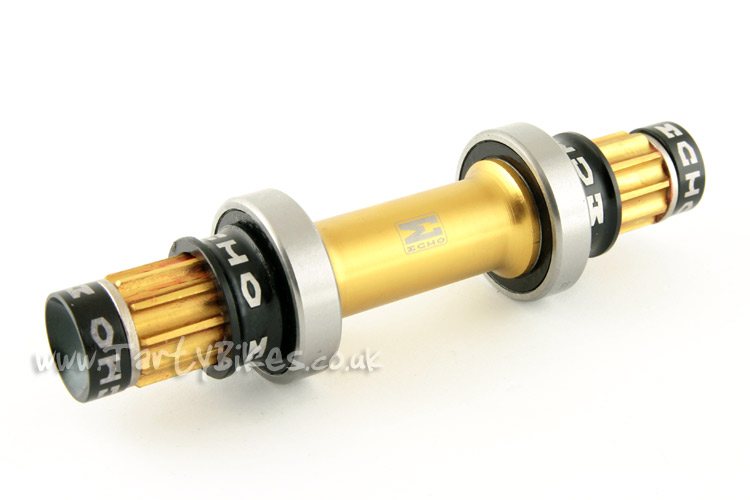
| Echo Urban isis / pic from TartyBikes |
In the series of articles about geometry, I begin with the value which has the most evolved in recent years, but also the easiest to explain, just to start soft : the bottom bracket height.
10 years ago, an high BB was located ten millimeters below the virtual line connecting the axes of wheels (for simplicity for the uninitiated, I'll say "-10" in this case). Today, weapons of competition are at least +50. For simplicity I will only talk about 26", although the actions of the BB height are the same whatever the size of wheels. And there's only three years, one +35 BB was considered standard.
Why do we place the BB higher and higher, and why not directly go to +120 (the value is not chosen randomly, it is the height that asked Marc Vinco to Koxx's boss for his promodel) ? For some very simple reasons actually.
First the BB height affects the overall stability of the bike, whether on two wheels or the rear wheel. And by stability I mean "ability to maintain the position without correction." Regarding stability with two wheels on the ground, it is the BB height from the ground that affects this ability. This is the same distance (BB height from the ground) that will allow a 20" (with bottom bracket at 80 relative to the virtual line, etc, etc ...) to be more stable on rear wheel a 26" with a +80 BB, because we will consider the height of the BB from the ground when we are on the rear wheel. Smaller wheels = more stable on rear wheel.
But the pogo-position is strongly influenced by the BB height relative to the virtual line (always the same sentence...), etc... More the BB is low, the harder it is to get on rear wheel, but also to stay. And vice versa of course. But the low BB has an advantage for the tap : it facilitates it.
So, after this explanation, why not go to +120 ? Just to maintain some stability with two wheels on the ground.
And why does the BB high have copiously brightened in recent years ? To follow the evolution of techniques. The tap no longer exists there, and is replaced by gestures requiring high promptness to put the bicycle on the rear wheel (bunny-up, pedal-up, bunny planted), or stay stable on it (side-hop or little pogos).
This article is huge ? Yes, but it is the easiest articles about geometry. See you soon !